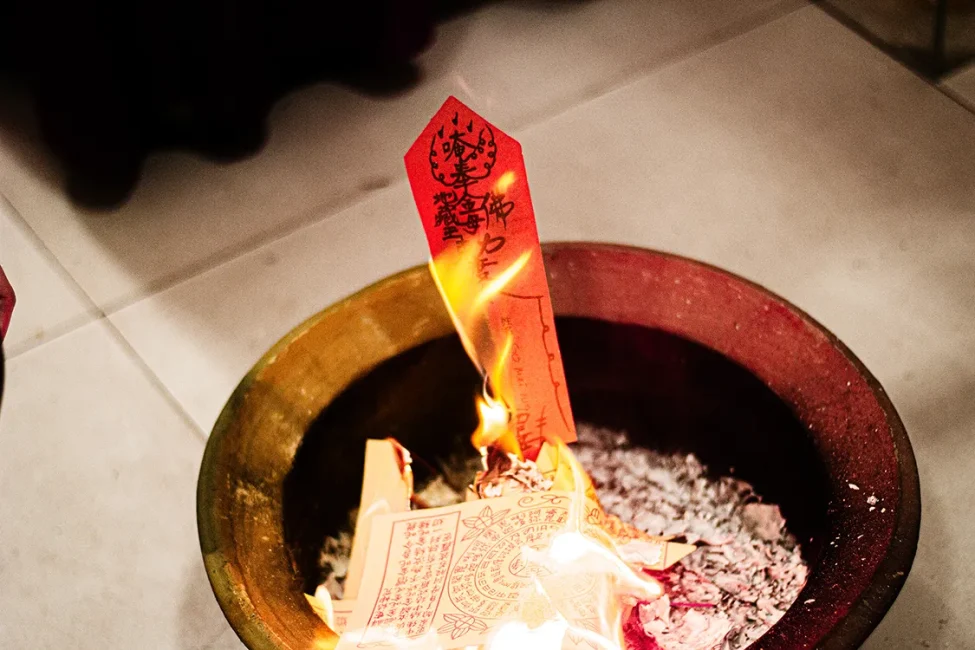
My grandmother, Go Mei Ing, passed away at 91 on 22 February 2023. In Chinese belief, red symbolizes grace and readiness — a sign of a life lived completely. That’s why her body was covered with a red blanket instead of white, the usual color for mourning.
The funeral followed Buddhist customs, led by my uncle, the only one among her children who still practices Buddhism. My father and uncle converted to Islam decades ago, while the others are Catholic. We stood together — Muslim, Buddhist, and Catholic — in a room filled with incense smoke, paper money, and candles meant to guide her to the next life.
Among the items in her coffin was a small ring from my childhood, her favorite until the alphabet of my name “S” came off of it. Bobo had lived with us for years. When her memory faded, she often called my name and followed me everywhere. After she passed, I realized that was what I missed the most.
It took me nearly a year to look through the photographs from the funeral. Editing them was not easy, since all the images showed the moment where everything would be different. But finishing the photos felt necessary. In a way, it became a quiet reminder that grief doesn’t end, it just changes shape. There was a kind of pressure in learning to move forward, in trying to live as if things were the same when they no longer were.
Looking at them now, a year later, they record not only her death, but also how our family shared the same space of grief, regardless of our different paths.